I have written two long posts about protecting SurrealDB on my Talos home-lab cluster with Kasten. This is the short version. If you only read one thing:
- SurrealDB is one database with seven data models: relational, document, graph, full-text, vector, geospatial and time series.
- It has no write pause, so a disk snapshot alone is only crash-consistent. Butreads each database in one transaction, so the export is consistent while writes continue.surreal export
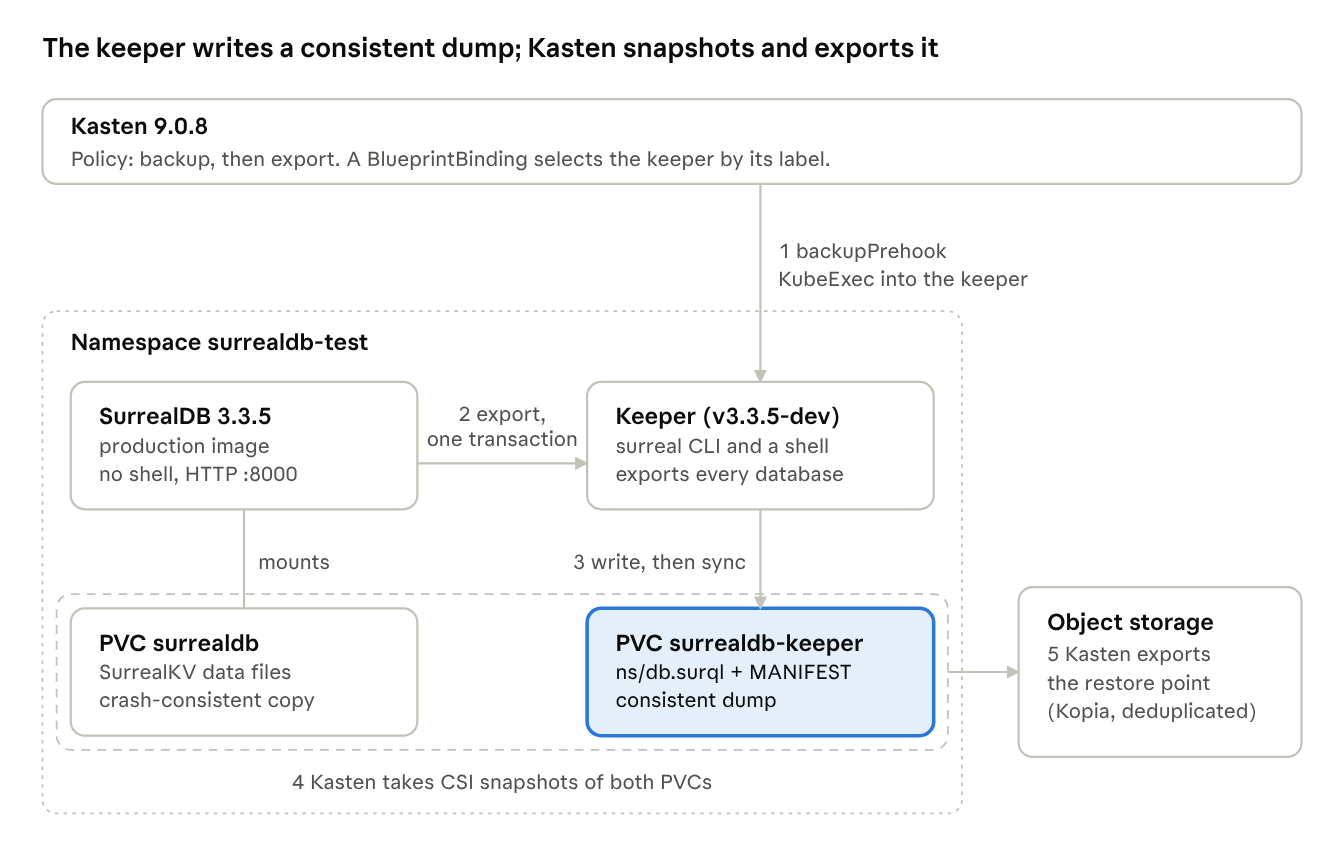
- Kasten turns that export into real protection: a small keeper pod writes the export to its own volume before each backup, and Kasten snapshots the whole namespace and copies it off-cluster.
- One backup covers every model, including the indexes, the functions and the database users, because the export writes definitions as well as data.
- I proved it by breaking all seven models at once and restoring from object storage: all 7 health checks went red, and a restore took them back to green in 2 minutes 38 seconds.
Why bother?
Availability is not resilience. Kubernetes, or a managed service such as SurrealDB Cloud, keeps the database running, but it keeps serving a bad migration or a mistaken script just as faithfully. Getting the data back to a known good point, and being able to move it to another cluster, is on us.
How it works
- Before each backup, Kasten runs a blueprint that execs into a small keeper pod. The keeper runsfor every database onto its own volume, then flushes it to disk withsurreal export.sync
- Kasten snapshots the whole namespace: the app, SurrealDB, the keeper, the Secrets and both volumes. Then it exports the restore point to object storage.
- On restore, Kasten brings everything back, and the blueprint removes each database and re-imports it from the consistent dump.
Nothing pauses writes, and nothing in the restore is done by hand.
Seven models, one backup
In SurrealDB these are not seven systems. They are tables, fields, edges and indexes in one database, so one export captures them all:
| Model | Used for in the demo shop | What the export brings back |
|---|---|---|
| Relational | Product catalogue | Typed table, unique index, rows |
| Document | Customers | Schemaless records as they are |
| Graph | Who bought what | Every edge, plus the stored functions |
| Full-text | Review search | The analyzer and the BM25 index |
| Vector | Similar products | The HNSW index and the embeddings |
| Geospatial | Nearest store | The location points |
| Time series | Live order feed | Every time-ordered event |
Break it, restore it
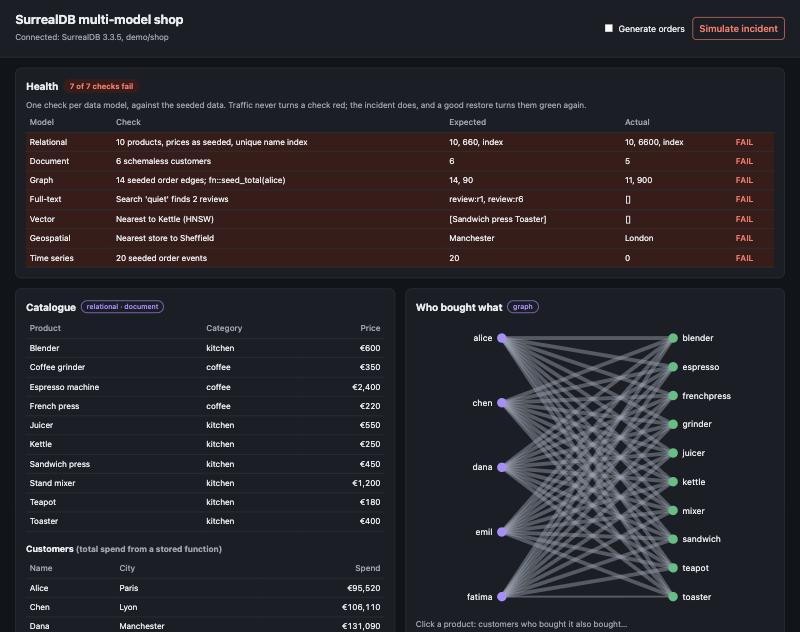
The demo app has a Simulate incident button that damages every model at once: prices times ten, a customer and their orders deleted, the review table and the vector index dropped, a store removed. Then I restored the namespace from the copy Kasten had exported to object storage.
| Step | Result |
|---|---|
| Incident | 0 of 7 checks pass |
| Restore from object storage | 2 minutes 38 seconds |
| After restore | 7 of 7 checks pass, the app reconnects by itself |
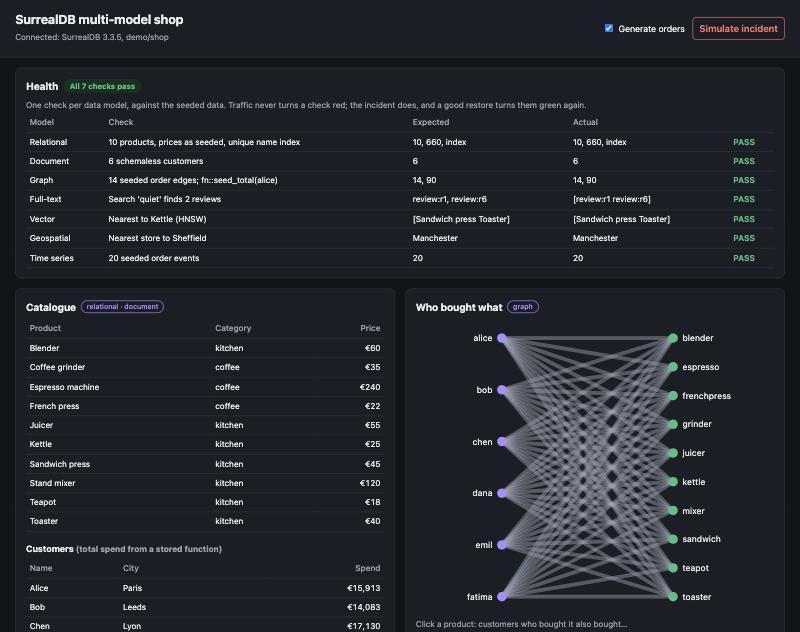
One lesson from doing it for real: the restore re-creates the database, which silently drops SurrealDB live queries. The data was perfect, but the app’s live feed went quiet until I taught it to subscribe again. Test what your clients hold on the server, not just the rows.
Numbers worth knowing
| Measurement | Result |
|---|---|
| Exports taken during continuous writes | 5 of 5 consistent |
| Restore from object storage to a healthy app | 2 min 38 s |
| Re-export with no changes | 0.7% of the first export |
| Re-export after 1% of records changed, consecutive keys | 6.4% |
| Re-export after 1% of records changed, scattered | 51% |
The last two rows are the surprise. Kasten’s export deduplicates, but the dump is written in key order, so changes spread across a table touch almost every chunk. Time-ordered keys, such as SurrealDB’s
Read more
- Protecting SurrealDB on Kubernetes with Kasten: the full walk-through, the Talos gotchas and the deduplication measurements.
- One database, seven models: protecting all of SurrealDB with Kasten: each data model, the demo app and the restore in detail.
- The keeper blueprint and the demo app, both open source.
Tested on Talos 1.12.6, Kubernetes 1.34.1, Kasten 9.0.8 and SurrealDB 3.3.5. It is a home-lab demo with a small dataset, so run the same test with your own data before you rely on it.